
Living and Working in Japan: Some Tips
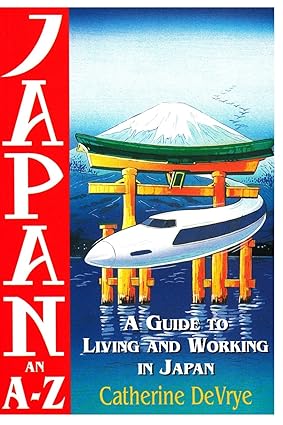
Catherine DeVrye lived and worked in Japan as IBM’s HR Manager. Here’s an extract from the book she wrote to help others avoid some of her own faux pas.
BOWING
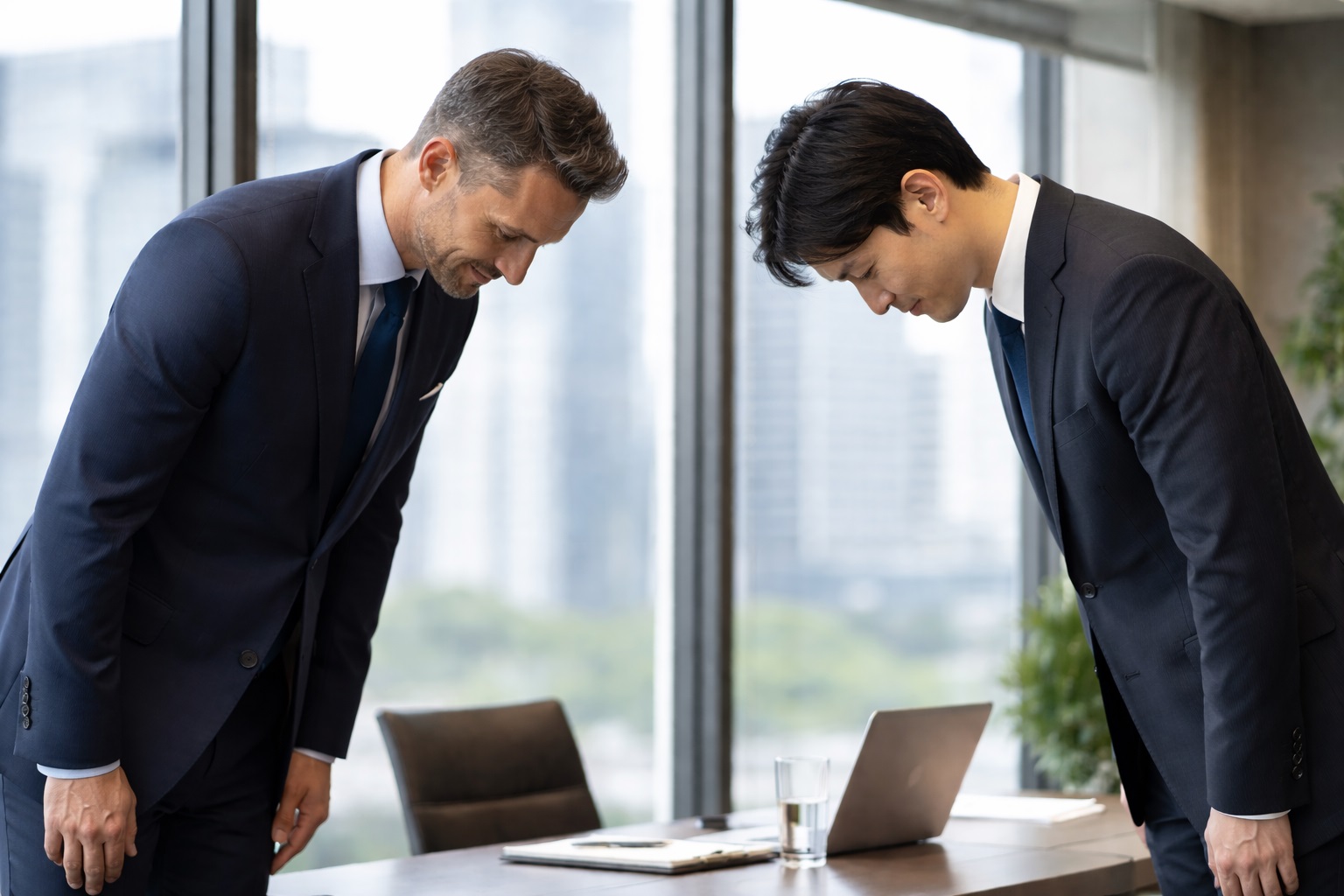
There have been entire books devoted to bowing and business cards. I will not attempt to delve into all the intricacies of whether one should bow at a 45 or 90 degree angle, but will simply cover the basic things one needs to know about these topics.
Foreigners are not usually expected to bow. However, you should follow the lead of your Japanese counterpart. If your Japanese host bows, you will probably want to offer a similar bow. If they extend their hand, do likewise. These days, Japanese usually prefer to shake hands with Westerners but don’t judge an individual as a wimp if the grasp is somewhat weaker than you would expect in the West. Remember, it’s a different culture and most Japanese are no more familiar with the proper pressure to be applied to a handshake than Westerners are with the nuances of the appropriate bow.
Generally speaking, the deeper the angle of the bow the more respect one offers to the opposite party. There seem to be infinite variations on the appropriate degree of the angle of the bow, the number of times one should bow, the length of time spent in the bent position, where the hands should be placed etc. However, in this day and age, it is unusual that Westerners would be expected to adhere to the strict etiquette of bowing behaviour.
One may hear the odd story of seemingly endless bowing whereby each party tries to ‘outbow’ the other to indicate respect, because no one wants to be the first to stop. The best course of action is simply to follow the lead of the other party as to whether the greeting is a handshake or a bow. If it is the former, I would usually offer a small bow as well. If it is the latter, I would bow at approximately the same angle as the person I was meeting-but only once. I believe it is important to feel as natural and warm as possible when being introduced. It is difficult for your genuine personality to shine through if you are in an uncomfortable position for any length of time.
BUSINESS CARDS
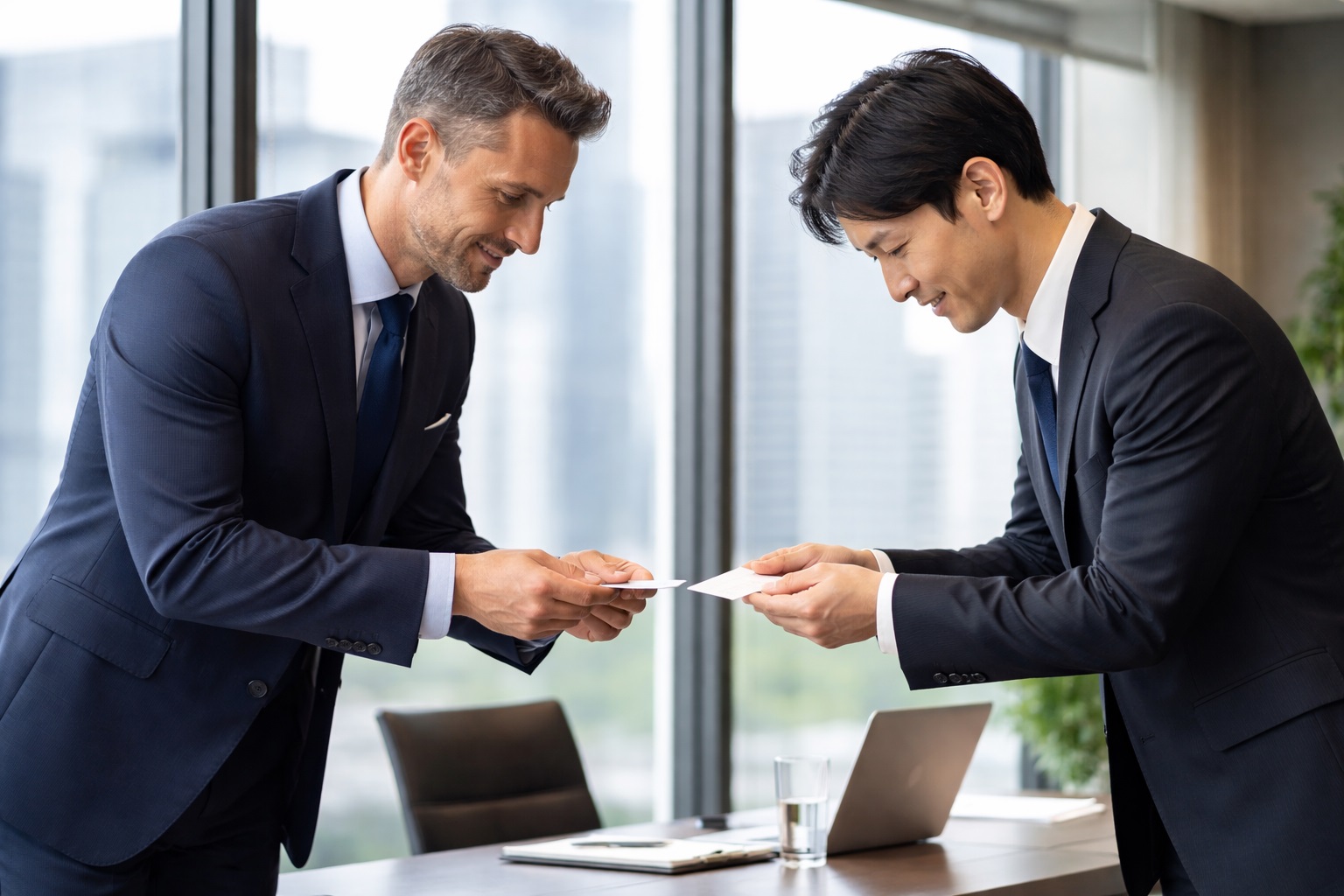
The key thing to remember is never (I repeat never) be without a business card. You would do well to adopt the American Express slogan: ‘Don’t leave home without it!’ A business card (meishi) is essential to do business in Japan. It should have your name, title, address, phone number, email address etc. It should be printed in English on one side and in Japanese on the other. It is extremely important that your title is carefully translated because your business card provides associates with an immediate indication of the appropriate status with which you should be regarded. The card should be printed on high-quality paper and only presented to someone if it is in pristine condition.
Immediately dispose of any with ragged edges or smudge marks. You know the ones I mean the accumulated collection in your wallet which have deteriorated over time or got mixed up with ones which have been presented to you. I would suggest you actually carry business cards in a separate holder, preferably a prestigious leather one as some counterparts will judge not only your card but the overall presentation. There may also be inadequate space in your wallet for the large number of business cards you should always have on hand.
It’s always wise to carry twice as many as you expect to hand out in case the person you are meeting brings associates along. It would be expected that you would exchange cards with everyone present. You should not exchange business cards with people you have already met as it implies that you have forgotten them.
Present your card with the Japanese print face up and facing the receiver so it can be easily read at a glance. Hand and accept cards with both hands. Always carefully study and acknowledge the importance of the card of the person who is presenting you with their credentials. Nod and smile before carefully putting it away. Don’t put it in your back pocket as it is considered an insult to sit on someone’s identity! It is also inappropriate to write on another’s meishi. Doing so is tantamount to scrawling on the very face of the provider.
With business cards printed on both sides, you are unable to use them for speech notes at the various speeches you will inevitably be asked to give! So, if you’re like me and need a few key points scribbled down unobtrusively on the back of a small card which can be held neatly in the palm of your hand, bring those leftover cards from home for that purpose.
In addition to business cards, many Westerners living in Japan also have ‘home cards’ printed. These contain your name, address and phone number in Japanese and your native language. The back of the card consists of a map depicting the immediate neighbourhood where you live, with major landmarks highlighted. As street addresses may be rather confusing for even the most dedicated taxi driver to logically decipher (there is no continuous numbering system or street naming), ‘home cards’ can save a great deal of frustration. They are also useful for home deliveries of any sort if handed to the proprietor at the time of purchase.
DISCRETION AND LOSS OF FACE
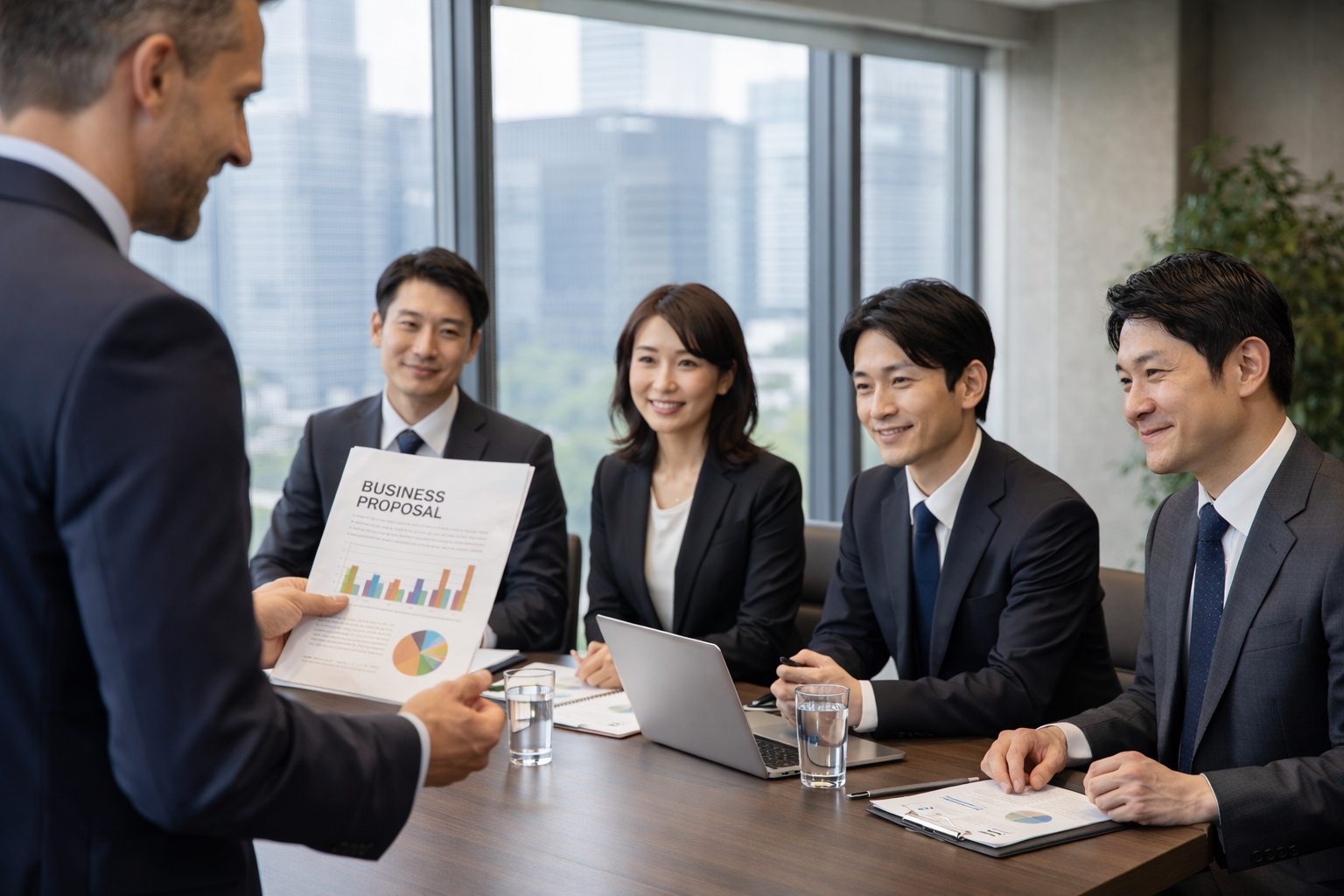
It is important never to cause anyone to ‘lose face’ when dealing with Japanese. This traditionally meant that one should always show outward respect to an individual, especially a superior, even if such respect was not warranted. Many Japanese still adhere to this reverence to more senior staff but it is no longer a universal practice to agree automatically with someone simply because of their position in the organisation. However, it is still essential that you never criticise anyone in public nor raise your voice in discussions. By the way, this isn’t bad advice to follow when doing business in any country.
Be careful not to criticise other people or other people’s ideas. In the West, we usually (but not always!) accept constructive criticism of our ideas. We do not take it personally if criticism is offered in a non-emotive, objective way with suggestions for improvement. Most managers are comfortable with some form of brain-storming to improve an original concept and seldom expect their first proposal to be adopted in entirety without alterations.
In Japan, there is a greater likelihood that any criticism of a business plan or idea could be taken as a personal criticism of the individual who made the submission. Therefore, if there is a problem with a proposal, it is a challenge to determine how to make modifications without implying criticism. I wish I could suggest some magic formula to do so. It is not that simple, but try to refrain from dismissing an idea outright. You may wish to nod and say that is an interesting suggestion and then ask for their opinion of your comments.
For example, rather than say I don’t think that will work because… say: That is a very interesting idea which I think we should fully investigate. I also have an idea which I would welcome your views on so we can come up with the most desirable overall solution which is best for everyone’.
The Japanese comfortably differentiate between reality and a socially acceptable facade. Tatumse is the acceptable facade. Honne is the reality or hidden truth. Embracing the honne philosophy allows governments, organisations and individuals to conscientiously avoid revealing the precise, entire truth, without repercussion. In other words, they can still tell the ‘truth’ without telling the truth, the whole truth and nothing but the truth.
For example, you may hear the legend of the establishment of Toyota Motor Company whereby the founder sold his only asset, a weaving loom, to raise capital for Japan’s first car factory. This is the latemar, the acceptable facade. What you are unlikely to hear is the other side of the story whereby the Japanese government actually provided half of the capital to the company and gave it tax-free concessions for five years. These actions, in essence, forced General Motors and Ford out of the Japanese market. That is the bonne, the reality of the hidden truth. That is not to detract, for a moment, from the tremendous success of Toyota, but simply to illustrate a common reluctance to openly discuss the less favourable aspect of any situation.
The concept of bonne also applies to unisex toilets. Oftentimes, I would blush when emerging from a cubicle to meet a man at a urinal. But, as far as the Japanese are concerned, there is no cause for embarrassment when encountering a member of the opposite sex in such a situation. The person is simply seen as invisible. They are not noticed because they are not really there, so there is no need for embarrassment?!?
Many Western friends would voice their annoyance that Japanese always pretended to be polite and friendly in a working environment; but behind your back, you were secretly resented as a Westerner. I honestly can’t comment whether that is true or not. Quite frankly, I didn’t care. I would much prefer to have people outwardly helpful and not know what they said behind my back than have them be uncooperative and abrasive to my face. Maybe my staff really did think I was nothing more than a dumb gaijin but they certainly never gave me that impression.
Titles are very important in Japan. Within any organisation, the title on one’s business card should be indicative of status within the hierarchy. It is common that titles are designed to at least create an illusion of advancement within a company. Fortunately, the title which appeared on my business card was of sufficient stature to compensate for the obvious fact that I was a female. Some companies may still expect employees to address a manager by their title rather than their name. For example, one would greet the chief executive officer as ‘President-san (Mr President) rather than ‘Matsumoto-san’ (Mr Matsumoto). Concern about loss of face was one key reason why automatic teller machines were slow to be fully utilised in Japan. When they were first installed, they were only operative during banking hours so they could be readily repaired if any problem arose. This resulted from the stated fear that if one such machine ran out of cash, a newspaper could report it and that particular bank would lose face. Losing face is so serious that the government actually dictated banks only opened automatic teller machines when they could be fully staffed, thus diminishing some of the obvious productivity gains.
I recall two incidents where I unintentionally caused other individuals to lose face. The first instance was when a very thin man slipped down a gap on the subway platform. I was astounded that no one nearby rushed to help him before an oncoming train was likely to arrive. I ran over and invoked the assistance of two rather reluctant bystanders as we pulled him up. I was amazed that he didn’t offer a word of thanks. I learned later that this was due to two factors. He not only experienced embarrassment and loss of face; but the other two Japanese guys had apparently ignored him because they didn’t want to force a feeling of indebtedness. I had some difficulty comprehending this totally different reaction to what I would have had if someone had rescued me from danger. I was equally bemused when, some weeks later, I fell asleep during my language lesson. My teacher dismissed my apologies and remorse saying, ‘No, it is I who should apologise for being such a boring teacher’. It all relates to loss of face. I felt so embarrassed for making her lose face, that I never again dozed.


You must be logged in to post a comment Login